

📞 Call Now

How Lone Star Endocrine Associates Grew Patient Bookings by 124% in 6 Months

Brand image for HeartCare Cardiac Clinic: a doctor presenting a red heart with an ECG trace, with an ultrasound monitor and medical equipment to the right, plus the slogan 'Expert Care. Stronger Hearts.'

Increase In Website Leads

Increase in Impressions

Monthly Organic Visits

%

Increase in GMB Calls

The Challenge

The core problem was painful in its simplicity: a respected four-location specialty group was being out-ranked by smaller competitors with far less clinical credibility. When a prospective patient in the metro searched for an endocrinologist nearby, a term carrying roughly 48,000 monthly searches in the US, the practice rarely appeared in the local pack or on the first page. That single gap was handing high-intent patients to rivals every single day, and no amount of clinical excellence could compensate for being unfindable at the moment of search.

Several issues compounded the visibility problem at once. The four Google Business Profiles were inconsistently optimized, with mismatched categories, thin descriptions, and uneven review volume from one location to the next. The website leaned on a single generic services page trying to rank for everything, which meant it ranked well for nothing in particular. There were no dedicated, condition-specific pages targeting how patients actually search, phrases like thyroid doctor or diabetes doctor in a given city. On top of all that, the site carried zero presence in AI-driven search results, so the growing share of patients asking assistants for a specialist recommendation never encountered the practice at all. For a healthcare provider competing on local intent, this combination was costing real appointments month after month.

The Solution

Our strategy was built around a clear principle: match how patients genuinely search, then dominate those moments across every location. Rather than chase national rankings or broad informational keywords, we focused the entire campaign on high-intent, local, condition-specific search, the exact queries a person types when they are ready to book an appointment. This discipline is what defines effective SEO services for medical practices, and it shaped every decision that followed.

The plan rested on four pillars working in concert rather than as a disconnected checklist. First, a complete local SEO overhaul to turn all four Google Business Profiles into lead-generating assets instead of passive listings. Second, a content architecture rebuilt around individual conditions and individual cities, so each location could rank in its own market for its own services. Third, an authority and trust layer using schema markup and credibility signals to prove to Google that this was a credentialed medical group worth ranking. Fourth, a generative engine optimization layer designed to get the practice cited inside AI Overviews and chat assistants, a channel most competitors were ignoring entirely. Each pillar reinforced the others, and together they formed a single coordinated campaign.

Techniques

Execution is where strategy either earns results or falls apart, so this section breaks down precisely what we did, in the order we did it. The five techniques below ran as a connected flow, each one building on the last, and every technique ties back to a specific KPI. The small chart under each step shows the measurable impact that technique delivered on its own.

Technique 1: Location-Specific Landing Pages
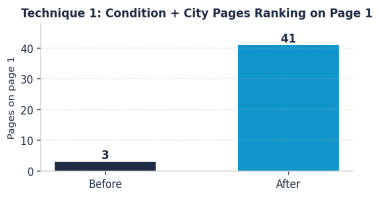
We started by replacing the single catch-all services page with a structured set of pages, one for each condition crossed with each city the group serves. A patient searching for thyroid care near a specific location now found a page built for exactly that intent, complete with local context, provider credentials, and clear booking paths. This expansion widened the practice footprint across the metro and gave every location its own competitive surface area, lifting the number of pages ranking on page one from a handful to several dozen.

Technique 2: Google Business Profile Optimization at Scale
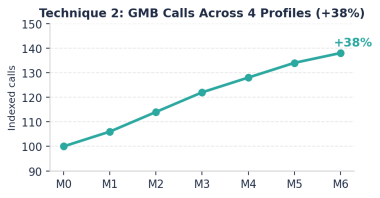
With the landing pages live, we turned to the four Google Business Profiles, standardizing and enriching each with accurate categories, complete service lists, geo-tagged photos, and consistent name, address, and phone details. We also implemented a structured review-generation workflow, since review volume and recency rank among the strongest local signals and act as a major trust cue for patients comparing specialists. Within weeks the profiles shifted from static directory entries into active sources of inbound calls across every location.

Technique 3: Condition-Focused, Patient-First Content
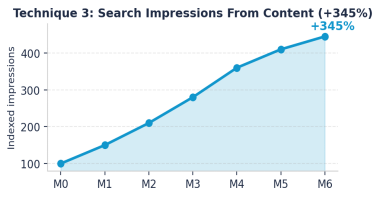
Next we produced authoritative content around the conditions the practice treats, written to satisfy both search engines and anxious patients researching their symptoms. We supported this content with links to credible medical authorities such as the American Diabetes Association and the Endocrine Society, which strengthened topical authority and gave readers genuinely useful next steps. As the content library matured, search impressions climbed steeply month over month, feeding the top of the patient funnel.
Line chart: indexed impressions rise from 100 at M0 to 450 at M6, +345%.

Technique 4: Schema and Trust-Signal Deployment
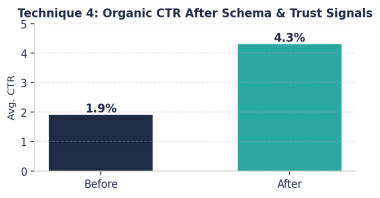
To convert that rising visibility into clicks, we added medical clinic, physician, and FAQ schema across the site, and surfaced provider qualifications, certifications, and hospital affiliations prominently throughout. For a Your Money or Your Life medical site, these trust signals are not optional extras, they are the foundation Google uses to decide whether a health page deserves to rank at all. Making credentials both machine-readable and visible to patients more than doubled the organic click-through rate on the practice listings.
Bar chart: CTR rises from 1.9% before to 4.3% after applying schema and trust signals.

Technique 5: Generative Engine Optimization
To convert that rising visibility into clicks, we added medical clinic, physician, and FAQ schema across the site, and surfaced provider qualifications, certifications, and hospital affiliations prominently throughout. For a Your Money or Your Life medical site, these trust signals are not optional extras, they are the foundation Google uses to decide whether a health page deserves to rank at all. Making credentials both machine-readable and visible to patients more than doubled the organic click-through rate on the practice listings.
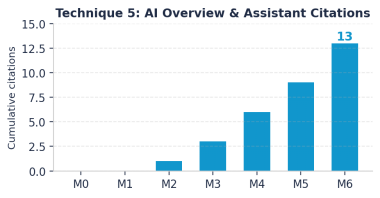
Bar chart titled 'Technique 5: AI Overview & Assistant Citations' showing cumulative citations by month: 0 at M0/M1, about 1 at M2, 3 at M3, 6 at M4, 9 at M5, and 13 at M6.

Results After 6 Months

Six months in, the numbers validated the strategy across every KPI we set at the outset. As the per-technique charts above show, each lever compounded into the outcome rather than acting in isolation. The headline results break down as follows:

More Website Leads

More Search Impressions

Local Pack Ranking

AI Search Citations

Website leads grew 124% in six months, the metric the practice leadership had defined as the entire point of the engagement.

Search impressions rose 345% as the new condition-and-city pages began ranking, feeding a steady 50+ monthly organic visits from high-intent patients.

GMB calls increased 38% across all four Google Business Profiles, a direct result of the local pack visibility and review work.

The practice moved from the third page to a consistent top-three local pack position for the core endocrinologist search in each primary city.

Condition-specific terms covering thyroid and diabetes care ranked on page one across the metro, widening the practice footprint.

The group earned 13 citations inside AI Overviews and assistant responses, capturing a discovery channel that had previously sent it zero patients.

Conclusion

The Lone Star Endocrine Associates engagement demonstrates a repeatable truth in healthcare marketing: clinical excellence means little if patients cannot find you at the moment they are searching. By focusing relentlessly on high-intent local search, rebuilding the practice presence around how patients actually look for care, and extending that presence into AI-driven discovery, ClinicSpots Digital Services turned an invisible four-location group into a dominant local choice in just six months. The 124% growth in leads was never the product of a single clever tactic, it was the result of a disciplined, KPI-driven campaign where local SEO, content, trust signals, and generative engine optimization all pulled in the same direction. For any specialty practice losing patients to less-qualified competitors simply because of search rankings, this case is proof that the gap can be closed, and closed fast.

Is your website quietly losing patients?

ClinicSpots Digital Services audits healthcare websites against real patient behaviour, then builds a prioritised roadmap to fix what is costing you inquiries. Get a free proposal at www.clinicspotsdigitalservices.com.

Scan the code