

How ClinicSpots Digital Services Built AI-Search Visibility and #1 Local Rankings for a Pune Gastroenterology Practice
A healthcare digital marketing success story — Pune, Maharashtra
Organic clicks
Liver specialist (GMB)
Cited in ChatGPT
%
SEO site score
The Situation
A leading gastroenterology practice in Pune approached ClinicSpots Digital Services with a solid website but three clear gaps holding back growth in one of India’s most competitive local healthcare markets:
Scattered rankings.
Most keywords sat at positions 2–8, visible but rarely in the top three, where the clicks are.
Zero AI visibility.
Patients increasingly ask ChatGPT and Google AI Overviews for doctors; the practice appeared in none of those answers.
Inconsistent local pack.
The Google Business Profile wasn’t winning the map pack for high-value terms like liver, pancreatitis, and colonoscopy care.
The brief: push rankings into the top three, build answer engine optimization visibility, and turn local search into a measurable patient-acquisition channel, all while reinforcing trust in a YMYL medical category.
The Solution
ClinicSpots Digital Services ran a multi-pronged digital marketing for doctors programme — technical SEO, a content engine, GEO/AEO optimization, and off-page work as parallel workstreams across the month.
Step 1: SEO-Optimized Blog Production
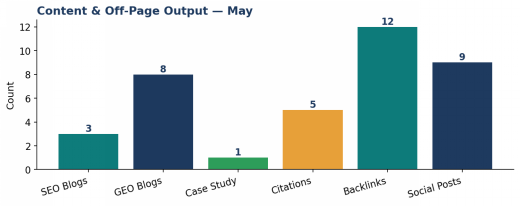
3 condition-focused blogs, fully optimized. IBD in infants, acid reflux & esophageal cancer risk, post-appendectomy bloating.
-
On-page SEO: title tags, meta descriptions, structured H1–H3 headings, image ALT tags, and canonical tags on every post.
-
Link architecture: keyword-rich URLs with internal links to service pages and authoritative outbound references.
-
Intent-matched topics: each blog answers a real patient question with commercial pull-through, doubling as a soft lead-gen asset.
-
Humanized copy: written to read naturally and pass AI-detection checks while staying medically accurate.
Step 2: GEO Blog Program (Generative Engine Optimization)
8 GEO blogs engineered to be cited by AI. Pancreatic cyst vs pseudocyst, early pancreatic cancer signs, fatty liver grading, FibroScan, ERCP vs MRCP, and more.
- Answer-first format: direct-answer openings, concise definitions, and comparison tables AI assistants can quote verbatim.
- Schema markup: FAQ, Article, and MedicalProcedure structured data so engines parse and surface the content cleanly.
- Question-led targeting: topics framed around the exact phrasing patients type into ChatGPT and Google AI Overviews.
- Built on the principles of generative engine optimization, optimizing to be the source, not just to rank.
Step 3: Authority Content Asset
1 long-form clinical case study published. A patient success story on early colon-cancer detection was built as a flagship trust asset, not just another blog.
- E-E-A-T signal: a real clinical outcome demonstrates first-hand expertise, authority, and trust, the signals Google weighs most in YMYL health content.
- Topical authority: deepens the site’s coverage of cancer care, strengthening the whole gastroenterology cluster.
- AI-citable structure: a clear problem-diagnosis-treatment-outcome narrative LLMs can lift and quote in answers.
- Patient reassurance: a documented recovery story builds confidence for prospective patients researching their options.
Step 4: Keyword Ranking Optimization
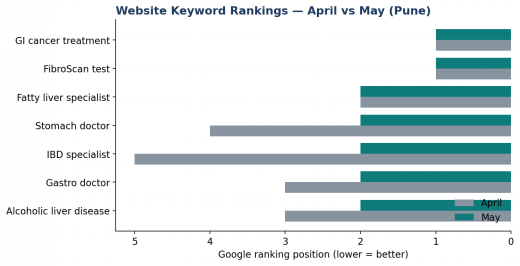
High-intent local terms, tracked monthly. By May, most tracked website keywords had moved into the top three.
- Priority targeting: focused on commercial, in-Pune terms like “GI cancer treatment,” “FibroScan test,” and “fatty liver specialist.”
- On-page tuning: titles, headings, and body copy aligned to each target term and its search intent.
- Monthly tracking: rank movements monitored term-by-term to double down on what was climbing.
Step 5: GMB Optimization & Local SEO
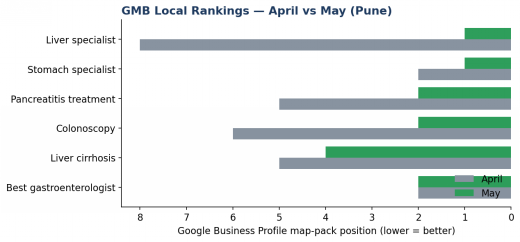
Sharp gains in the local map pack. Consistent posting, profile optimization, and local SEO services pushed several treatment terms into the top two.
- Profile optimization: categories, services, business description, and photos tuned for high-value treatment searches.
- Regular GMB posts: steady updates, offers, and patient-education posts to signal an active, trusted listing.
- Review & NAP hygiene: consistent name-address-phone data and review management to strengthen local trust signals.
Step 6: AI / GEO Visibility
Cited inside ChatGPT for both head terms. “Best gastroenterologist in Pune” and “gastroenterologist in Pune” inside AI answers, not just traditional search.
- Compounding signals: GEO blogs, the case-study asset, and schema worked together to make the practice an AI-citable source.
- Both head terms covered: visibility for the two highest-volume local queries that patients actually ask.
- Future-proofing: presence in AI answers protects discoverability as search shifts from links to recommendations.
Step 7: Off-Page — Citations, Link Building & Syndication
Wider referral footprint, protected link quality. A white-hat off-page programme to build authority safely.
- Local citations: authoritative directory listings with consistent name-address-phone data.
- Niche link building: relevant referring domains from health and local sources.
- Content syndication: reach extended across Medium, Pinterest, SlideShare, Tumblr, and AnyFlip.
- Quality control: backlink profile monitored continuously to avoid spam exposure.
Step 8: Social Media Activity
Steady Facebook & Instagram cadence. Patient-education content that drove engaged users back to booking pages.
- Consistent posting: regular reels and posts to keep the practice top-of-mind with local audiences.
- Education-first content: symptom explainers and treatment tips that build trust and shareability.
- Freshness signals: active profiles reinforce the legitimacy that search engines and AI models weigh when ranking local providers.
Step 9: Technical Health & Authority
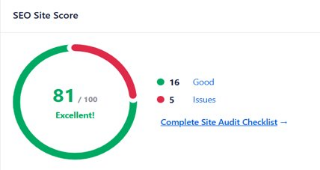
SEO site score: 81/100 (“Excellent”). 16 checks passing, only 5 minor issues outstanding.
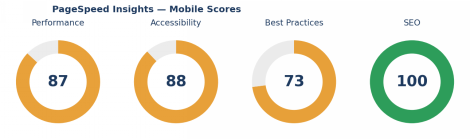
- Page speed: strong mobile scores 87 performance, 88 accessibility, 73 best practices, and a perfect 100 SEO.
- Crawl & index health: clean technical foundation so new content gets discovered and ranked quickly.
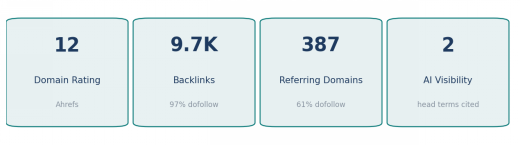
- Authority growth: a growing backlink profile (387 referring domains) continued to lift domain strength.
Results (April → May)

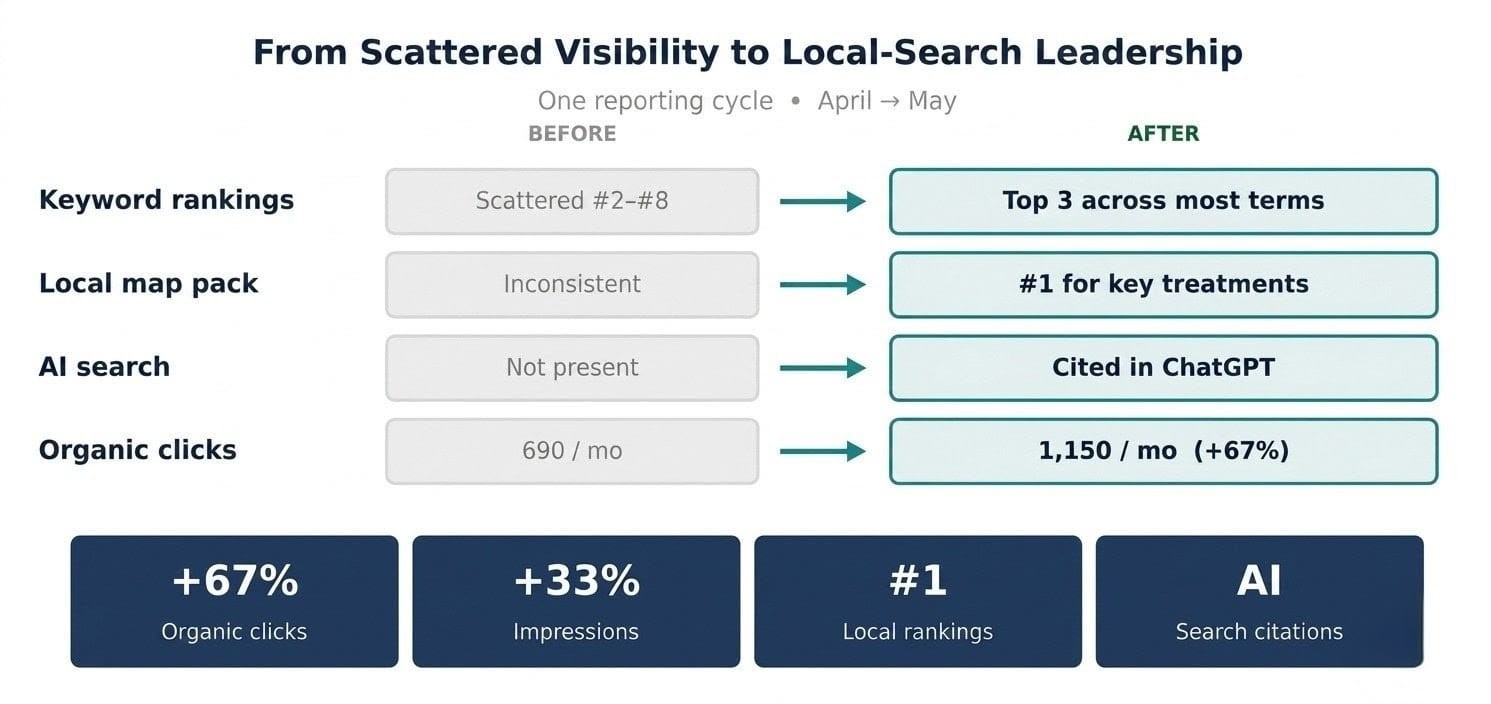
Local map-pack dominance: “liver specialist” #8→#1, “stomach specialist” #2→#1, “pancreatitis treatment” #5→#2, “colonoscopy” #6→#2 on GMB.
Website rankings consolidated: “IBD specialist” #5→#2, “stomach doctor” #4→#2; “GI cancer treatment” and “FibroScan test” held #1.
AI-search visibility: now cited in ChatGPT answers for both primary head terms in Pune.
Search Console growth: clicks 690→1,150 (+67%), impressions 112K→149K (+33%), CTR 0.6%→0.8%.
Conclusion
In a single reporting cycle, gastroenterology digital marketing plus technical SEO, GEO/AEO content, and local-SEO execution moved a Pune practice from scattered visibility to local-search leadership.
Is your website quietly losing patients?
ClinicSpots Digital Services audits healthcare websites against real patient behaviour, then builds a prioritised roadmap to fix what is costing you inquiries. Get a free proposal at www.clinicspotsdigitalservices.com.