

How ClinicSpots Digital Services Diagnosed The Problem And Built the Roadmap to Fix It
Turning guesswork into evidence: a behaviour-data audit that traced lost patient inquiries to their exact cause.

Prioritised fixes identified in the audit
Current average Google position (GSC)
Conversion-blocking P0 issues found
%
Issues verified with user-behaviour data
The Challenge
A multi-doctor obstetrics and gynaecology clinic operating a live, traffic-generating website faced a critical conversion gap: visitors were arriving but almost none were converting into patient inquiries. Despite steady site traffic, the practice was failing to translate audience interest into appointment requests, leaving significant patient-acquisition potential unrealized.
ClinicSpots Digital Services was engaged to conduct a conversion and SEO audit with a prioritised remediation roadmap. Using behaviour-data diagnosis grounded in Microsoft Clarity heatmaps, session replays, and click data, every friction point was identified and verified rather than assumed. The audit translated these findings into a 25-point fix roadmap, sequenced by priority, effort, and timeline, to systematically close the gap between site traffic and patient inquiries.
The Solution
A multi-doctor obstetrics and gynaecology clinic approached ClinicSpots Digital Services with a familiar frustration. The clinic had an established medical reputation and a live website that brought in visitors, yet very few of those visitors ever became patient inquiries. The assumption was that the site simply needed more traffic.
ClinicSpots took a different view. When a website attracts visitors but converts almost none of them, the problem is rarely traffic volume. It is far more often friction: small, invisible barriers between an interested patient and a completed inquiry. The clinic also held a reasonable average Google position of 7.5, which made the low conversion even more telling. Patients were finding the site. Something was stopping them once they arrived.
Rather than guess, ClinicSpots set out to measure exactly where and why patients were dropping off.
The Diagnosis: A Behaviour-Data Audit
ClinicSpots ran a structured audit of the website, but did not rely on opinion or best-practice checklists alone. Every suspected issue was verified against real user-behaviour data captured with Microsoft Clarity: heatmaps, scroll-depth tracking, session replays, and click analysis. This meant each finding was backed by evidence of how patients actually used the site, not by assumption.
The audit examined six areas of the website and surfaced a connected set of problems.
| Area | What the audit found | How it was verified |
| Forms | A math CAPTCHA and rigid phone-field validation blocked or frustrated patients trying to submit an inquiry | Rage clicks on the submit button and form-field errors spiking on mobile input |
| Navigation | A broken link in the main navigation sent visitors to a dead end | Dead clicks concentrated on the navigation in the click heatmap |
| Performance | Uncompressed images and render-blocking scripts slowed the site, especially on mobile | Bounce rate and scroll-depth drop-off measured against load behaviour |
| Tracking | No baseline analytics or funnel events existed, so nothing could be measured or proven | Funnel events were missing entirely from the behaviour-analytics setup |
| Trust | Reviews, certifications, and credibility signals were buried below the fold or hidden | Low scroll depth meant most visitors never reached the trust content |
| Conversion | Visitors who reached the contact page often left without submitting, and there was no recovery path | Heatmap and submit-rate data showed high-intent visitors abandoning |
The most damaging findings were the simplest. A math CAPTCHA and an over-strict phone field were quietly rejecting genuine patients at the final step, and the audit could see it happening: rage clicks on the submit button, and form errors spiking the moment mobile users tried to enter their number.
The Strategy: A Prioritised Remediation Roadmap
A list of problems is not a plan. ClinicSpots translated the audit findings into a roadmap of 25 specific, actionable fixes, each one scored on three dimensions so the clinic always knew what to do next and why.
Priority
Each fix was rated P0, P1, or P2, so conversion-blocking issues were tackled before cosmetic ones.
Effort
Each fix carried an effort estimate, so high-impact, low-effort work could be done first.
Timeline
Each fix was placed in a window — Week 1, 30 days, 60 days, or 90 days — to create a realistic rollout schedule.
Verification signal
Each fix named the exact metric or behaviour signal that would confirm it had worked, so progress could be proven rather than assumed.
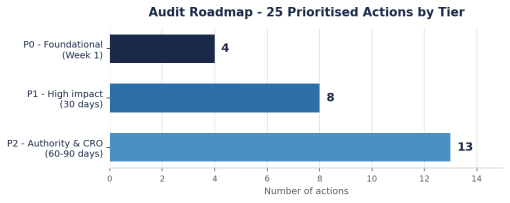
The Roadmap at a Glance
The 25 actions were grouped into three tiers, moving from foundational conversion fixes to longer-term authority and optimisation work.
| Tier | Timeline | Representative actions |
| P0 | Week 1 | Remove the math CAPTCHA, fix phone-field validation, show inline form errors, unify all contact forms into one component, and repair the broken navigation link. |
| P1 | 30 days | Make the booking CTA and phone number sticky, compress images and lazy-load media, defer non-critical scripts, enable caching and a CDN, capture baseline metrics, and tag funnel events. |
| P2 | 60-90 days | Move testimonials and trust badges above the fold, add doctor cards and per-doctor CTAs, build a multi-step booking flow, add an FAQ section with schema, and retarget abandoned contact visits. |
Phase 1 — Remove the Conversion Blockers (Week 1)
The first week targeted the four P0 issues directly responsible for lost inquiries: replacing the math CAPTCHA with an invisible, frictionless alternative, accepting any reasonable phone-number format, showing live inline error messages so patients could self-correct, unifying every contact form into one reliable component, and repairing the broken navigation link.
Result: The patient inquiry path was cleared of the barriers the audit had proven were causing drop-off, addressing the conversion problem at its source.
Phase 2 — Speed, Stability, and Measurement (30 Days)
The 30-day phase made the site faster and finally measurable: compressing images, deferring non-critical scripts, enabling browser caching and a CDN, and making the booking CTA and phone number persistent on scroll. Crucially, baseline metrics and funnel events were captured so that, for the first time, the clinic could measure its own performance.
Result: The site was made faster and more stable, and a proper measurement foundation was put in place so every later change could be tracked and proven.
Phase 3 — Trust, Booking, and Recovery (60-90 Days)
The final phase strengthened how the site earns and converts trust: moving testimonials and certifications above the fold, adding clear doctor cards with their own call-to-action, building a guided multi-step booking flow, adding an FAQ section with structured data for search visibility, and setting up retargeting to recover visitors who left the contact page without submitting.
Result: The roadmap laid out a clear path to convert the trust the clinic had already earned offline into completed inquiries online.
The Outcome
The defining value of this engagement was clarity. The clinic began with a vague sense that its website underperformed and an assumption that more traffic was the answer. It finished with something far more useful: a precise, evidence-backed understanding of exactly what was wrong and a sequenced plan to fix it.
What the clinic gained:
A diagnosis, not a guess
Twenty-five specific issues identified, each verified against real user-behaviour data.
A clear first move
Four conversion-blocking P0 issues isolated as the urgent priority, separated from lower-impact work.
A realistic plan
Every fix scored by priority, effort, and timeline, turning a problem list into an executable roadmap.
A way to measure success
A verification signal attached to every action, plus baseline tracking so future gains can be proven.
With an average Google position of 7.5, the clinic was never short of visibility. The audit showed that its real opportunity was conversion — and gave it a disciplined, prioritised path to capture the patients it was already reaching.
Why This Approach Works
Most website problems are invisible to the people who own the site. Owners see their pages through the eyes of someone who already knows where everything is. Patients do not. A math CAPTCHA, a strict phone field, or a buried testimonial feels minor until behaviour data shows how many real inquiries it quietly costs.
By grounding every finding in heatmaps, session replays, and click data, ClinicSpots Digital Services replaced opinion with evidence — and replaced a long, unsorted wishlist with a roadmap the clinic could actually execute, in the right order, with a way to prove each step worked.
In the Clinic’s Words
“[Optional anonymised testimonial placeholder — two to three sentences from the practice describing the value of finally understanding why the website underperformed. Can be attributed simply as ‘The Practice Owner’ with no name. Remove this section if no quote is available.]”
– The Practice Owner, a private OB-GYN clinic
Conclusion
ClinicSpots Digital Services helped this clinic see its own website clearly for the first time. The breakthrough was not a campaign or a budget increase. It was diagnosis before treatment: measuring real patient behaviour, tracing lost inquiries to their exact causes, and converting that evidence into a prioritised, executable roadmap.
A website that brings in visitors but converts few of them does not usually need more traffic. It needs the friction removed. With a clear audit, a sequenced plan, and a way to measure every change, this clinic is positioned to turn the visibility it already has into a steady stream of patient inquiries.
Is your website quietly losing patients?
ClinicSpots Digital Services audits healthcare websites against real patient behaviour, then builds a prioritised roadmap to fix what is costing you inquiries. Get a free proposal at www.clinicspotsdigitalservices.com.